
BREW
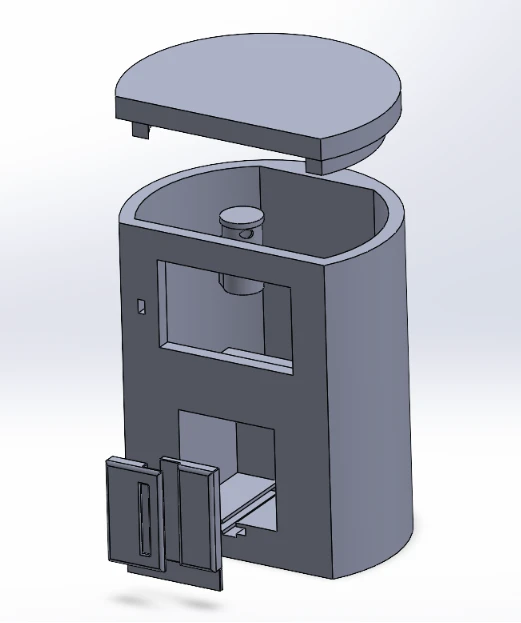 BREW / Design illustration
Project Overview
Point-of-care (POC) testing gives patients the option of portable coagulation analyzers, allowing testing to be conducted at their convenience. However, current POC coagulation analyzers on the market cost upwards of $800, limiting accessibility.
A study conducted simplified blood clotting (PT/INR) tests using a smartphone camera to detect the motion of a copper particle in a blood sample, yielding a strong correlation with commercial devices. BREW extends the findings of this research to develop a cost-effective POC coagulation analyzing device based on the same principles, with the goal of delivering accurate and reliable results comparable to industry-standard devices.
System procedure breakdown
- Sample insertion. A small blood sample, alongside a copper ball, is inserted into a custom-designed cup and introduced into the device.
- A dispenser delivers thromboplastin, a coagulating agent, into the sample to initiate the coagulation process.
- A vibrating motor is activated to drive the system, causing the copper ball to oscillate within the blood.
- Positioned directly above the sample, a camera continuously records the oscillation of the copper ball throughout the test.
- As the blood coagulates, the clot increases the viscosity of the medium, damping the ball’s motion so its amplitude of oscillation progressively decreases. The system monitors this in real time.
- When the ball’s amplitude falls to a predetermined threshold, the timer stops. This time is used to calculate the international normalized ratio (INR), which is used to determine whether the blood falls within a normal coagulation range.
Mechanical component
The frame contains the thromboplastin reservoir and dispenser, along with a custom-printed, disposable cup that inserts into a sliding locking mechanism for ease of use.
Electrical component
- A motor that pushes/delivers the thromboplastin into the sample.
- A vibrating motor that drives the system so the copper ball oscillates.
- A display screen that outputs the calculated values.
- A power lever/switch that turns the system on or off.
- A custom-designed PCB for wiring organization and as a medium for the power switch.
Computer vision component
A camera positioned above the cup detects the oscillation and movement of the copper ball via computer vision, calculates the amount of displacement of the ball, and applies a set threshold limit to identify the coagulation end-point.
Current stage
CAD Design Final Edits, Computer Vision Code, Assembly & Validation
Design illustrations
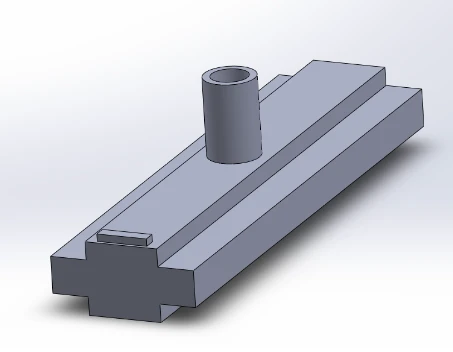
CAD images from project slides supplied by BMES @ UCF.

Morgan Sahirman
Project Lead · BMES Projects Director
- Major
- Mechanical Engineering
- Year
- Fourth Year
