
GRACE
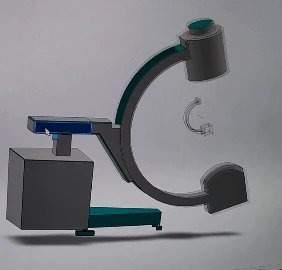 GRACE / Design illustration
Project Overview
The Gesture-Controlled C-Arm project aims to improve procedural workflow by allowing physicians to position medical X-ray imaging equipment through intuitive hand gestures, without breaking sterility. The concept originated from observing the challenges of operating a C-arm during clinical procedures, where physicians rely on a separate operator to interpret their hand signals and manually reposition the machine.
Gesture Recognition and Control
The team developed a computer vision system that recognizes 14 distinct hand gestures and maps them to the C-arm's five directions of movement. Using a dataset of more than 7,000 images, the gesture recognition model achieved 95% accuracy. Safety-focused control logic requires a deliberate start gesture, permits movement in only one direction at a time, and uses a closing gesture to stop the system. The control software is to be tested in a 3D simulation to validate gesture recognition and movement before physical hardware integration.
Mechanical Design and Prototyping
Recognizing a gesture is only half the challenge; the machine must also execute the corresponding movement. On a conventional mobile C-arm, an operator manually releases brakes and pushes the arm into position. Enabling gesture control requires redesigning these manual adjustments as motor-driven mechanisms.
The team is developing a full-scale C-arm prototype with five independently controlled directions of movement: up and down, side to side, forward and backward, rotation around its axis, and orbital motion along the C-arm's arc. Each direction requires its own motor, drive mechanism, and supporting structure. Because the mechanisms are stacked, each stage must support the weight and forces of the components above it. The 7 kg arm also hangs off-center from its supporting joints, creating twisting and bending loads that increase during motor acceleration and deceleration.
To address these challenges, the team evaluates forces at critical joints and selects components based on structural loading and positioning requirements. The design incorporates a worm gearbox for controlled rotation, a screw-driven linear stage mounted on precision rails for linear movement, and a belt-driven rotational mechanism that turns the entire vertical assembly to achieve lateral positioning. These components are selected to minimize mechanical play and structural flex, helping the physical prototype achieve precise, predictable movements that correspond to the gesture-control system.
Electrical Systems and Motion Control
The electrical system connects the gesture-recognition software to the C-arm's physical movements. The team is developing the motor-control architecture needed to translate recognized gestures into coordinated movement across five independent axes. This involves integrating motors, motor drivers, power distribution, and control electronics to enable responsive and reliable positioning. The control system must also coordinate movement commands with the project's safety logic, ensuring that motion begins only after a deliberate start gesture, proceeds in one direction at a time, and stops when the designated closing gesture is detected.
Current Progress
The gesture recognition software is complete, 3D simulation is in the works, and the team is currently building and integrating the physical prototype. By combining computer vision, machine learning, mechanical design, and motion control, the project seeks to demonstrate a more intuitive approach to C-arm positioning that could streamline procedural workflows and reduce reliance on manual operator adjustments.
- Technologies:
- SolidWorks, KiCad, Python, Unity, Arduino
- Engineering Focus:
- Computer Vision, Machine Learning, Mechanical Design, Structural Analysis, Robotics, Motion Control
Design illustrations
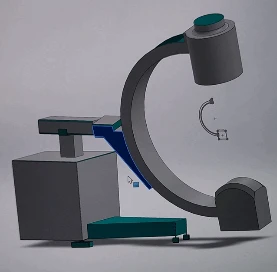
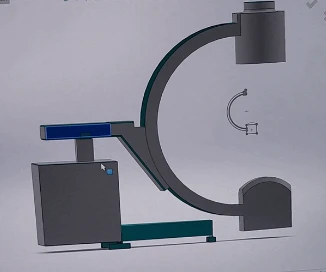
CAD images from project slides supplied by BMES @ UCF.

Ali Ghounem
Project Lead
- Major
- Mechanical Engineering
- Year
- Fourth Year
